Fine Arts Museums of San Francisco – May 1, 2001
catalogue for one-man show at Robert Sandelson Gallery, London, 2000
HELNWEIN
The art of Gottfried Helnwein cannot be properly considered without surveying the terrain of modern and contemporary art from which it developed. To understand Helnwein is not just to see what movements and artists he embraced and was influenced by, but also what he rejected.
For Helnwein, creativity is not a vocation but a mission. His art is the visual equivalent of a contact sport. It not only has put Helnwein at odds with much of the history of post-war art, but also has positioned him in the forefront of the highly regarded confrontationalist movements of contemporary art so active in America and Europe today.
ART newsroom.com Joanna Hayman-Bolt – December 6, 2000
one-man show at Robert Sandelson Gallery, London, 2000
HELNWEIN
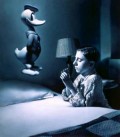
Any artist who sites Donald Duck and Jesus Christ as the most important influences in their art must be worth taking a look at.
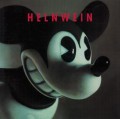
In the row of pristine gallery fronts in London's Cork street, you cannot miss Gottfried Helnwein's show; it's the one with the gigantic Mickey Mouse staring out at you.
The Robert Sandelson Gallery has given us a stunning show of the infamous, Austrian born artist's recent work. Helnwein is on a mission to find the answers to questions that no-one in Austria would give him; such as why the post-war republic portrayed itself as a victim rather than as one of the first main perpetrators of Nazism.
Tastes Like Chicken; Columbus, Ohio – October 31, 2000
Interview, 2000
HELNWEIN
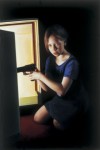
These are the images of a man consumed by free will. A man with a gift and a craft and a passion to challenge the mediocrity of what has already been established. A man whose opinions embody everything authority does not want you to believe in. His name is Gottfried Helnwein, and he recently discussed his 30+ year career with Tastes Like Chicken's Insane Wayne Chingsang.
"The Darker Side of Playland" Childhood Imagery from the Logan Collection, exhibition catalogue – September 1, 2000
San Francisco Museum of Modern Art, 2000
THE DARKER SIDE OF PLAYLAND
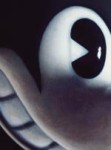
(excerpt) Other works in the exhibition present the dark side of cartoon characters. The prevailing narrative structure of many cartoons is a cycle of one's character's unrelenting attacks on another. Yet the violence of these scenarios is subverted and humor achieved by the lack of any permanent injury to the victim and the gleeful nonchalance of the adversary even during the most aggressive assault. Static representations of wounded or menacing cartoon characters can expose the violence and eliminate the humorous punch line. In Gottfried Helnwein's painting Mickey (plate 24), Mickey Mouse's physical features, which usually contribute to his appeal become a thin veneer of looming attack. Blown up to a monster scale and rendered in an austere gray palette, Mickey's smile is deceptive.
Omnibucket, US – June 15, 2000
Scorpions
Cyril Helnwein chats with Klaus Meine and Rudolf Schenker of the legendary rock band, The Scorpions, June 2006:
Klaus Meine: "Blackout" was an amazing cover, it was so powerful, and it was a real piece of art. We were always interested in having rock n roll and art really close together. "Blackout" became a signature artwork for the Scorpions and it still is a classic to this day all over the world. It stands out as one of the best albums we did and we're very proud of it.
Jewish Chronicle, London – June 2, 2000
One-man show at the Robert Sandelson Gallery, London, 2000
HELNWEIN, ONE MAN SHOW, ROBERT SANDELSON GALLERY, LONDON
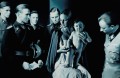
London show for Gottfried Helnwein, Artist's haunting Nazi-era Images
Austrian artist Gottfired Helnwein's powerful and haunting paintings provide a disturbing commentary on Nazism and the Holocaust, regularly provoking outraged reactions from right-wingers in his native land and in Germany. "I was amazed how much pictures could reach into the hearts and minds of people - and how much they would talk to me about it," he told the JC. "For me, art is like a dialogue. My art is not giving answers, it is asking questions."
REUTERS City, International / Art – June 1, 2000
One Man Show, Robert Sandelson Gallery, 2000
THE SHOCK OF THE REAL
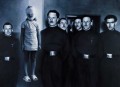
A year or so back, an exhibition called Sensations caused a few upsets, first in London and then in New York. Central to the reaction was a large-scale portrait of a child-killer assembled from, if I remember correctly, the palm prints of children. So far, so bland. The shock element in art has been much talked about in the last five years but art that actually shocks has been thin on the ground during the same period.
Step forward then, Gottfried Helnwein.
By and large, if art is going to shock, it better have something shocking to say,and it's clear that Helnwein has found that.
Dazed and Confused, London – May 31, 2000
Dazed and Confused, London, 2000
GOTTFRIED HELNWEIN, LONDON, 2000
Helnwein, the controversial Austrian artist whose works is currently on show at the Robert Sandelson gallery in London, has always been a difficult personality to pin down. As a young man in 1969, when most Western teenagers were smoking dope and taking acid, he was busy speaking out against the latent fascism embedded at the heart of Austrian society. A keen believer in the value of expressive freedom, he was expelled from the experimental school of the Higher Graphic Institution in Vienna for painting a portrait of Adolf Hitler in his own blood.
What's On, London – May 17, 2000
Gottfried Helnwein, LONDON, 2000
NEW KIDS OUT TO SHOCK
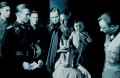
A blonde Madonna, dressed as if she were spending an evening at the opera, presents her child to the watchful eyes of Nazi SS Guards, One officer looks as if he were studying the child's genitals, perhaps to see whether he has been circumcised. Dark hair parted severely to one side and fleshy baby cheeks lending a slight and comical hangdog expression, the young child presents something of an eerie resemblance to the Führer.
The Guardian – May 16, 2000
One-man show at the Robert Sandelson Gallery, London, 2000
GOTTFRIED HELNWEIN, THE MAN WHO USED HIS OWN BLOOD TO PAINT HITLER
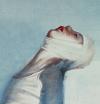
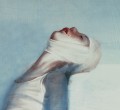
Kate Connolly meets Gottfried Helnwein, the Austrian who is still confronting his country's Nazi past. It could have been worse. At least he doesn't look like his self-portraits, in which bandages swathe his head, bent forks pull his mouth into a mocking smile and blood drenches his torso. Helnwein, 52, is a master of the scandalous and the art of shocking. The artist Robert Crumb once said of him: "Helnwein is a very fine artist and one sick motherfucker." "You can get things moving in a very subtle way, you can get even the strong and powerful to slide and totter - anything, actually, if you know the weak points and tap at them ever so gently by aesthetic means."